
India's auto retail sector achieved record-breaking sales of 2,96,71,064 units in FY26, a 13.3% increase, primarily driven by the implementation of GST 2.0 which reduced the tax burden on mass-segment vehicles, according to the Federation of Automobile Dealers Associations (FADA).

'Every year we import approximately $70 billion worth of gold -- closer to $72 billion in 2025-2026, an all-time record.' 'There is no parallel for this anywhere in the world. And this love for gold will not disappear overnight.'

'Once the currency goes out of the hand, then possibly your major challenge is that it will not come back.'

Retail inflation inched up to 0.71 per cent in November on rising prices of vegetables, protein-rich items, and fuel, government data showed on Friday. The consumer price index (CPI)-based retail inflation had fallen to a record low of 0.25 per cent in October, mainly due to lower prices helped by GST rate cuts and a favourable base.

The gems and jewellery industry anticipates challenging times following the government's decision to increase gold import duty to 15 per cent, a move that exporters warn could fuel the grey market and heighten smuggling risks.

Total, which had a few weeks back exited Royal Dutch Shell-led Hazira LNG import terminal in Gujarat, will join Adani in developing a 5 million tonnes a year import facility at Dhamra in Odisha. The two will also set up a joint venture to roll out a fuel retail network of 1,500 outlets, mostly on highways, in the next 10 years, Adani and Total said in a joint statement.
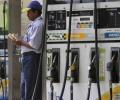
Sri Lankan President Anura Kumara Dissanayake has announced an economic relief package to mitigate the impact of the West Asia conflict, including fuel price reductions and support from India for petrol and diesel supplies.

The Indian rupee gained 2 paise to settle at 93.33 against the US dollar, driven by positive sentiment in domestic equity markets and renewed hopes for US-Iran talks, despite rising WPI and CPI inflation.
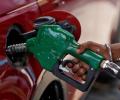
At present, India has 56,999 fuel outlets. Of those, only 6,276 are owned by private companies

The Indian government has doubled the daily quota of market-priced 5-kg LPG cylinders for migrant workers to ensure stable fuel supplies amidst global disruptions. This move prioritises household cooking gas and addresses the needs of migrant workers who often lack regular connections.

S&P Global Ratings warns that a sustained rise in crude oil prices to $130 per barrel could significantly slow India's economic growth, weaken fiscal metrics, and strain corporate and banking sector performance, potentially reducing growth by up to 80 basis points.

'Once the market decides it wants to go up, it goes up -- no amount of bad news can really hold it back.'

Tamil Nadu Petroleum Dealers' Association urged people not to panic-buy petrol or diesel, stating that 14 terminals in Tamil Nadu have enough stock to replenish 7,000-plus retail outlets as per their demand.

Vietnamese automobile major VinFast is rapidly expanding its retail network in India, aiming for 75 dealerships across 60 cities by the end of 2026, while also building a comprehensive EV ecosystem.
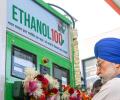
As of now, no firm has launched a flex-fuel vehicle in India, as these models are more expensive than comparable petrol-run vehicles.

The central bank is yet to consider actions such as a rate hike or mobilising dollar inflows from non-resident Indians to boost forex reserves as it cannot afford to continue with them for long when the rupee's internationalisation tops its agenda, explains Tamal Bandyopadhyay.
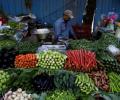
India's wholesale price inflation (WPI) increased for the fourth consecutive month in February, reaching 2.13 per cent, primarily due to rising prices of food and manufactured goods, according to government data.

If the conflict continues for a prolonged period, State-run oil companies may have to review retail fuel prices accordingly.

Analysts warn that global markets are significantly underpricing the risk of an oil price shock, with Brent crude potentially soaring to $150 per barrel if the West Asia conflict escalates or damages critical oil and gas infrastructure. This could lead to severe inflation and economic repercussions, particularly for import-dependent nations like India.

Loans against gold jewellery in India surged by an impressive 128 per cent year-on-year to nearly 4.28 trillion in February 2026, according to the latest Reserve Bank of India (RBI) data, significantly outpacing overall retail loan growth.

Even if there is an early agreement on a cessation of hostilities in West Asia, the price shock will not go away easily, points out A K Bhattacharya.
Responding to concerns raised by Leader of the Opposition Rahul Gandhi in the Lok Sabha, Petroleum Minister Hardeep Puri said it is the foremost priority of the government that the kitchens of over 33 crore families, especially the poor and the underprivileged, do not face any shortage of gas.

'So far our production is not affected. But every day the situation prolongs, it does bring risks in terms of shipments getting delayed.'

Though the government had earlier this fiscal explicitly decided to compensate Indian Oil, Hindustan Petroleum and Bharat Petroleum for the losses they incur on selling domestic LPG and kerosene through PDS by way of oil bonds, the finance ministry has not issued any bonds for the three quarters.

'The West Asia or the Gulf crisis has shown that what we develop as national infrastructure when things are not as bad as they could be, we forget to plan for adversities.'

West Asia conflict triggers sharp sell-off in Indian markets, with realty, banking and auto stocks leading losses amid energy shock fears.

Unified Payments Interface (UPI) transactions reached a record high in March, driven by festivities and the financial year closure, according to the National Payments Corporation of India (NPCI).

'The petrol lobby is very rich and strong.'

24 Indian-flagged vessels with 677 Indian seafarers were currently located west of the Strait of Hormuz, and four vessels with 101 Indian seafarers were stationed east of the strategic waterway.

Wholesale price inflation extended upward momentum for the third straight month, at 1.81 per cent in January, driven by an uptick in prices of food, non-food articles, and manufactured items on a month-on-month basis, government data showed on Monday.

Households should moderate large discretionary expenses for the time being.
'They should prioritise essential spending. They should maintain an emergency fund covering 6 to 12 months of expenses.'
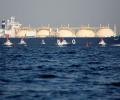
Analysts predict India will face oil price volatility and macroeconomic effects due to the escalating Iran crisis, though the country's oil supply chain is not yet structurally insecure.

RIL-BP currently produce gas from Dhirubhai-1 and 3 field and oil and gas from MA field, three of the over one-and-half dozen discoveries made in KG-D6 block
Retail inflation slipped to 1.54 per cent in September from 2.07 per cent in the preceding month mainly due to subdued prices of food items, including vegetables and pulses, according to government data released on Monday. The consumer price index (CPI) based inflation was 5.49 per cent in September 2024.

Qatar has halted liquefied natural gas (LNG) production after its facilities came under attack amid the ongoing West Asia conflict, disrupting supplies to India and squeezing feedstock availability for key domestic sectors.

Leading automakers in India, including Maruti Suzuki, Tata Motors, Mahindra & Mahindra, and Hyundai, reported increased vehicle dispatches to dealers in February, driven by sustained domestic demand.
Leading automakers in India, including Maruti Suzuki, Tata Motors, Mahindra & Mahindra, and Hyundai, reported increased vehicle dispatches to dealers in February, driven by sustained domestic demand.
Wholesale price inflation extended upward momentum for the second straight month, recording at 0.83 per cent in December 2025, driven by an uptick in prices of food, non-food articles, and manufactured items on a month-on-month basis, government data showed on Wednesday. Wholesale Price Index (WPI)-based inflation returned to positive in December, after witnessing a deflationary trend in the previous two months.

Two-wheeler (2W) major Bajaj Auto on Friday posted its highest ever quarterly revenue and profit during the third quarter of 2025-26 (Q3FY26). Bajaj Auto's consolidated net profit for the quarter grew by 25 per cent year-on-year (Y-o-Y) to Rs 2,749 crore, with the revenue also growing 23 per cent to Rs 16,204 crore.

Rural India outpaced urban centres in passenger vehicle sales in 2025, recording a growth of 12 per cent compared with 8 per cent in cities.
